(Revamping the blog. Please excuse the odd headings. Working on it!)

Writing History & Mysteries

When I'm not delving into historical research, I'm planning a character's demise.

The blog of Cindy Amrhein

Historian - Author - Abstractor

Silver Lake, NY at Sunset

Photo by Zach Amrhein

This is default featured slide 3 title

Go to Blogger edit html and find these sentences.Now replace these sentences with your own descriptions.This theme is Bloggerized by Lasantha Bandara - Premiumbloggertemplates.com.

This is default featured slide 4 title

Go to Blogger edit html and find these sentences.Now replace these sentences with your own descriptions.This theme is Bloggerized by Lasantha Bandara - Premiumbloggertemplates.com.

This is default featured slide 5 title

Go to Blogger edit html and find these sentences.Now replace these sentences with your own descriptions.This theme is Bloggerized by Lasantha Bandara - Premiumbloggertemplates.com.

Showing posts with label Wyoming County. Show all posts

Monday, April 27, 2015

W is for WYOMING County Historian's Office

Wyoming County Historian's Office
This is where I work as Assistant County Historian. We do genealogy requests, track down the history of abandoned cemeteries or an old building. We even found descendents to pass some silverware along to. You just never know what we will be asked to do.

The office of county historian has been around since 1947 collecting information on the county's history. We are open Monday through Friday 8-noon and 1-3:30 at 26 Linwood Avenue in Warsaw, NY 14569. All those file drawers on the right contain family files. We also have atlases, census records, copies of military pension records, cemetery records... well lots of stuff. Come visit sometime! Oh yes! We also produce a quarterly publication called Historical Wyoming, also since 1947 (except a few years in the 70s till they found another printer.) A subscription is only $10 a year for 4 issues of 28 pages, and no ads (send to address above). Click here for a free PDF issue.


Stay tuned for more history tidbits throughout the month of April!

The list to the other A-Z bloggers is here.

***
If your user name in comments doesn't lead to your A-Z blog, leave the URL so I can find you!
Here's how to do a clickable link to your blog in the comments section:

< a href="http://historysleuth.blogspot.com/">History Sleuth's Writings - Blogging A-Z</a >

Just replace my stuff with yours and take the space out between the < a and a > above.
(Had to put a space in or you would see a link instead of code. :)
Keep it in a note on your desktop so you can copy & keep hitting paste at every blog instead of retyping.

Share:

Friday, April 24, 2015

U isfor UFO


TRI-COUNTY TIMES (Arcade, NY)
Oct. 24, 1973 (Wednesday)
Wyoming County, NY had its share of UFO sightings in the 1950s-mid 70s.  We even made the government's "Project Bluebook" which is now available, with much redacted, through the freedom of information act. The government blamed far too many sightings on Venus or weather balloons. Below are some of our encounters:

PERRY HERALD
August 28, 1952
FLYING SAUCERS HERE

    It’s happened in Perry. A local resident, who asked that her name be withheld, reported sighting two flying saucers over Perry last Monday. Fearful that her story would not be credible in view of the discussion centering around the saucers the lady reported that the two objects were plainly visible during the daytime.
    The report here coincides with a report from Watkins Glen that a pair of flying silver balls had been sighted at Watkins Glen. The local resident had no knowledge of this report at the time she reported seeing the flying saucers here.

***
Buffalo Evening News 
August 29, 1952

WARSAW AUDIENCE REPORTS SAUCERS ‘PLAYING TAG IN SKY’

Special to the Buffalo Evening News
WARSAW, Aug. 29 - Residents of Murray St. in the center of this village, saw strange objects in the sky at intervals from 9:30 to 10 o’clock Thursday night.
    A group of boys, 12 to 14 were the first to spot the “saucers” darting through the northwestern sky. Douglas Rudgers, Gorden Abner, James Alfieri, Richard and Harold Lee and David Webster and Donald Webster Jr. were greatly impressed. So were their elders. Mrs. Rudgers, mother of Douglas, remarked: “I never believed in ‘flying saucers’ until I saw those things last night.”
    She pointed out that they didn’t streak across the sky and disappear but darted back and forth through the cloud formations “as though they were playing tag.”

Stay tuned for more history tidbits throughout the month of April!

The list to the other A-Z bloggers is here.

***
If your user name in comments doesn't lead to your A-Z blog, leave the URL so I can find you!
Here's how to do a clickable link to your blog in the comments section:

< a href="http://historysleuth.blogspot.com/">History Sleuth's Writings - Blogging A-Z</a >

Just replace my stuff with yours and take the space out between the < a and a > above.
(Had to put a space in or you would see a link instead of code. :)
Keep it in a note on your desktop so you can copy & keep hitting paste at every blog instead of retyping.

Share:

Sunday, April 19, 2015

P is for PROHIBITION

Perry Herald - October 31, 1917
The 18th Amendment on Prohibition was proposed by the United States Senate on December 18, 1917, and took until 1920 to pass-- but New York State already had their own liquor laws in place. Since before the turn of the century organizations were already active in their effort to curb crime and protect family values that were being deteriorated by, as they saw it, alcohol.

On the other side of the coin, by 1920 New York Governor, Alfred E. Smith, wanted no interference by the federal government in the matter of liquor sales as the state and county governments collected a large amount of revenue through liquor tax. Obviously, saloon operators were against it as well as legitimate liquor manufacturers. It would also cause a confusing problem for drug manufactures, pharmacists, and doctors as alcohol was often a main ingredient in prescriptions in the early 1900s.

A percentage of the general public, who enjoyed tipping one now and then, was against the idea for obvious reasons. Although many members of anti-alcohol groups were religious minded church goers, it soon became a conundrum behind the pulpit since wine was used during religious services by several denominations.

Most towns in Wyoming County, NY showed no great increase in crime during 1918-1933. There had always been laws in one form or involving liquor in regards to selling without a license or public intoxication, and since the advent of the automobile—driving while intoxicated.  This was the first time, however, laws restricted having alcohol in your home, druggists in their ability to prescribe medication that contained alcohol, and wine during church services. Residents of a dry town, who were essentially good citizens, were now considered law breakers for having alcohol. ....
 ***
 You can read my upcoming release as a short on Prohibition in Wyoming County later in 2015.
***

Stay tuned for more history tidbits throughout the month of April!

The list to the other A-Z bloggers is here.

***
If your user name in comments doesn't lead to your A-Z blog, leave the URL so I can find you!
Here's how to do a clickable link to your blog in the comments section:

< a href="http://historysleuth.blogspot.com/">History Sleuth's Writings - Blogging A-Z</a >

Just replace my stuff with yours and take the space out between the < a and a > above.
(Had to put a space in or you would see a link instead of code. :)
Keep it in a note on your desktop so you can copy & keep hitting paste at every blog instead of retyping.

Share:

O is for Milo H. OLIN, Inventor

Milo H. Olin is one of Wyoming County, NY's many inventors.
WINDSHIELD WIPING AND CLEANING APPARATUS 
Milo H. Olin, Perry, N. Y.
Application July 25, 1950, Serial No. 175,739

A wind shield wiper mechanism which can be controlled by a foot pedal, and which does not require the operator of the vehicle to remove his hands from the vehicle for starting the Windshield wiping operation. The apparatus is for wiping a windshield and for applying a cleaning liquid thereto which is so constructed that both operations are controlled by a single foot pedal.

The apparatus for wiping and cleaning a windshield which the driver can operate wholly with his foot, and which does not require him to remove either hand from the steering wheel. The only hand operation required is to stop the movement of the wipers by pulling on the knob 90. Furthermore, it will be seen that with the apparatus the cleaning liquid is delivered onto the windshield at its top.
***

Stay tuned for more history tidbits throughout the month of April!

The list to the other A-Z bloggers is here.

***
If your user name in comments doesn't lead to your A-Z blog, leave the URL so I can find you!
Here's how to do a clickable link to your blog in the comments section:

< a href="http://historysleuth.blogspot.com/">History Sleuth's Writings - Blogging A-Z</a >

Just replace my stuff with yours and take the space out between the < a and a > above.
(Had to put a space in or you would see a link instead of code. :)
Keep it in a note on your desktop so you can copy & keep hitting paste at every blog instead of retyping.

Share:

Friday, April 17, 2015

K is for KILLERS

More Wyoming County, NY History


Auburn Weekly News
May 23, 1878

AN ATROCIOUS PAIR OF MURDERERS FOR AUBURN PRISON.---William Brown and Jacob Eller were yesterday sentenced to Auburn prison for life, by the Wyoming county Circuit Court, for killing Mrs. George Minkle in December last, in the town of Bennington. The story of the murder is to the effect tat at midnight of December 22nd Mr. Minkle was awakened by some one violently rapping upon his door. He asked what was wanted, and a voice from outside demanded admittance, which was refused. He looked from the window and beheld three persons, two of whom he recognized as the prisoners now under trial. They threatened to kill him if he would not admit them, and when he again refused they beat in the door. Having gained admittance, they attacked Mr. Minkle with clubs and he was felled to the floor and rendered insensible.

Upon regaining his senses Mr. Minkle first realized the fact that the fiends were dragging his wife from the house. The woman screamed piteously, but the husband could offer no assistance, as he feared they would take his life. He accordingly ran to a neighbor's to procure help.

Upon his return his wife and the brutal wretches were nowhere to be found, and it was not until about daybreak that Mrs. Minkle's cold and lifeless body was discovered under an apple tree, a few rods distant from the house. The only clothing she had on her was her night-robe, and this was badly torn. There was evidence of a terrible struggle; locks of her hair were found on the ground near by. The Coroner's inquest, subsequently held, gave as it's verdict, "That the deceased, Mrs. George Minkle, came to her death at the hands of William Brown and Jacob Eller, and that her death was caused by strangulation and violence."

Stay tuned for more history tidbits throughout the month of April!

The list to the other A-Z bloggers is here.

***
If your user name in comments doesn't lead to your A-Z blog, leave the URL so I can find you!
Here's how to do a clickable link to your blog in the comments section:

< a href="http://historysleuth.blogspot.com/">History Sleuth's Writings - Blogging A-Z</a >

Just replace my stuff with yours and take the space out between the < a and a > above.
(Had to put a space in or you would see a link instead of code. :)
Keep it in a note on your desktop so you can copy & keep hitting paste at every blog instead of retyping.

Share:

J is for JAIL

The brick building behind the monument to the left is the
clerk’s office. To the left of that (white building)  is the
jail. The illustration is from F. W. Beers, History of
Wyoming County (1880).
Sheriff Day entered the cell on Sunday, November 20, 1892, expecting to see James Collins. The sheriff had made arrangements to move Collins the next day to Auburn Prison, but he wasn’t to be found. The sheriff had originally planned to move him Saturday but decided to wait because the prisoner was allegedly not feeling well. After his court appearance the previous Thursday he felt faint and complained of heart pain. He was given some medicine which he said made him feel better and Collins said he hoped he would feel better by Monday. Because of his alleged weakened condition Sheriff Day postponed his transport to Auburn Prison. Collins escaped alone in the wee hours of the morning.
Village of Warsaw, NY 1861
A push broom that had been lying outside his cell on Saturday morning came up missing. With the use of his makeshift tools he pried up the floor boards underneath his cot. It was either luck or knowledge from former jail guests that this was an area that had been worked before and never fixed properly. A previous prisoner had made extensive headway cutting through joists of 12” x 12” timbers to make a larger crawl area. Nothing was done to fix that other than to replace the floor boards over top. This is an entirely different side of the lower floor of the jail than Robinson and Redner began cutting through in January of the same year.

Collins then tunneled nine feet and dug through the foundation wall which the newspapers described as, “seven feet of poorly constructed concrete masonry.” He stored the rubble under his cot and mattress which hadn’t been checked since Tuesday when they gave him a new mattress.  All of this he managed in only four days.


A year passed and on December 13, 1893 during the Board of Supervisors Annual Meeting, Mr. Matthews moved, “… that the county assume the responsibility and liability of the payment of the reward offered by E. A. Day sheriff, for the apprehension of James Collins, who escaped from the Wyoming County Jail, Nov. 19th, 1892.” The motion was carried. The man who called himself James Collins was never caught. Of course, clever and charming as he was, he no doubt reinvented himself with a new name and a new identity, as many of them did. 


Stay tuned for more history tidbits throughout the month of April!

The list to the other A-Z bloggers is here.

***
If your user name in comments doesn't lead to your A-Z blog, leave the URL so I can find you!
Here's how to do a clickable link to your blog in the comments section:

< a href="http://historysleuth.blogspot.com/">History Sleuth's Writings - Blogging A-Z</a >

Just replace my stuff with yours and take the space out between the < a and a > above.
(Had to put a space in or you would see a link instead of code. :)
Keep it in a note on your desktop so you can copy & keep hitting paste at every blog instead of retyping.

Share:

Tuesday, April 14, 2015

I is for Inventor

FRANK M. FOOTE - Arcade, Wyoming County, NY


Castilian
Oct. 24, 1918
Frank M. Foote Granted Patent

   Frank M. Foote of Arcade has been granted a patent on a devise for unloading amesite from railroad cars, especially from cars of the two pocket variety.
   This patent makes possible a savings of about $50 in unloading one car.
   It seems that amesite comes in a hardened condition in the car and must be heated in order to get it out. This has always been a troublesome job.
   Mr. Foote had a large amount of the material to put on the road he built in Castile and hit upon the plan of putting perforated pipes into the bottom of each pocket of the car before it was loaded. Into these pipes he turned steam and in a short time he had the material so that it would run out.
   While he was engaged on the Castile contract State officials from all parts of the State came to see his device for unloading the material and were much impressed with the ease with which the work could be done.
   As soon as road building operations are resumed in this country the device will be in great demand.—Arcade Herald.

Application filed May 26, 1917.
Serial No. 171,145.

   Mr Foote states, “My invention relates to freight cars, and more particularly to means for heating the contents of the cars and for controlling the discharge of the contents therefrom. ...The primary object of my invention is the provision of means for heating the contents of a car and associating such means with controlling mechanism whereby the discharge of the contents from the car may be controlled.”

Stay tuned for more history tidbits throughout the month of April!

The list to the other A-Z bloggers is here.

***
If your user name in comments doesn't lead to your A-Z blog, leave the URL so I can find you!
Here's how to do a clickable link to your blog in the comments section:

< a href="http://historysleuth.blogspot.com/">History Sleuth's Writings - Blogging A-Z</a >

Just replace my stuff with yours and take the space out between the < a and a > above.
(Had to put a space in or you would see a link instead of code. :)
Keep it in a note on your desktop so you can copy & keep hitting paste at every blog instead of retyping.

Share:

H is for Historical Wyoming


Historical Wyoming began in 1947 with the first Wyoming County Historian, Harry Douglass. As the title suggests it is about the history of Wyoming County, NY. We are the only county historian's office in the state to publish a quarterly magazine.

It was originally printed by Arcade School for free and more than four issues a year. It was only out of print for a few years in the 70s after losing the school printing department. It began operations again under a different historian using a commercial printer and has run since then as a quarterly. Click here for a free issue (shown above) in PDF format.


Stay tuned for more history tidbits throughout the month of April!

The list to the other A-Z bloggers is here.

***
If your user name in comments doesn't lead to your A-Z blog, leave the URL so I can find you!
Here's how to do a clickable link to your blog in the comments section:

< a href="http://historysleuth.blogspot.com/">History Sleuth's Writings - Blogging A-Z</a >

Just replace my stuff with yours and take the space out between the < a and a > above.
(Had to put a space in or you would see a link instead of code. :)
Keep it in a note on your desktop so you can copy & keep hitting paste at every blog instead of retyping.

Share:

Thursday, April 09, 2015

E is for ED Don George, Wrestler


When Wyoming County, NY discusses its mark on the world of wrestling, Ed “Don” George often comes to mind, a World Heavyweight title holder during the 1920's and 30s. We have two more often overlooked title holders—brothers Conrad and John Albright, wrestlers from the early 1900s. When they began their wrestling careers they took on the names of “Con” and “Jack” Albright, respectively. In fact, it was Jack who “discovered” Ed Don George.

During the later part of 1929 Jack Albright wrestled a few bouts himself at the Boston Gardens, although training other fighters seemed to be his focus at this point in his career. He trained Gus Sonnenberg for the match against Ed “Strangler” Lewis in January of 1929 at the Boston Gardens. Sonnenberg beat Lewis securing the World Heavyweight title. Bout records show Jack was Sonnenberg’s trainer throughout the year, but he would soon discover and train another future champion this year as well—Ed Don George, of Java, NY.

In December of 1930 Ed Don George would come home from California to visit his family having just won the World Heavyweight title from Gus Sonnenberg. The following article about Mr. George is also a reflection on Jack Albright’s skill as a trainer.

Perry Herald
December 24, 1930

WYOMING BOY NOW WORLD’S CHAMPION
---------
Ed George of North Java Traveled Across Continent To Beat Sonnenberg
------------
COUNTY BOASTS CHAMPS
----------
George’s Victory Recalls Days of Con And Jack Albright, Pike Wrestlers
--------------
    Two of the smallest places in Wyoming county, Pike and North Java, boast of three world wrestling championships. When Ed George, University of Michigan graduate, came home from California Saturday night to spend a few days with his parents, Mr. and Mrs. Edward George at North Java, while on his way to Providence, R.I., he brought back the world’s championship in defeating Gus Sonnenberg. Journeying across the continent to meet Sonnenberg at Los Angeles, George surprised the wrestling world by his clean cut victory and for the next few weeks he will be busy defending his title.
     By a rather odd co-incidence George was discovered by Jack Albright of Pike, who won the world’s middleweight title in 1913 and it was Con Albright who in 1911 won the world’s welterweight championship, thus bringing to Pike and the Albright brothers double championship honors.
     There may be no gold in “them there hills” as the Californians would say, but everyone in Wyoming county knows that there are enough problems to wrestle with in the Pike and North Java hills to give any wrestler the proper background to defeat a Sonnenberg, Strangler Lewis or Farmer Bailey. So when Jack Albright began training George it was not long before Canisus college in Buffalo recognized his prowess and later he went to the University of Michigan where he became an intercollegiate champion and now world’s champion. ...

****

Stay tuned for more history tidbits throughout the month of April!

The list to the other A-Z bloggers is here.

***
If your user name in comments doesn't lead to your A-Z blog, leave the URL so I can find you!
Here's how to do a clickable link to your blog in the comments section:

< a href="http://historysleuth.blogspot.com/">History Sleuth's Writings - Blogging A-Z</a >

Just replace my stuff with yours and take the space out between the < a and a > above.
(Had to put a space in or you would see a link instead of code. :)
Keep it in a note on your desktop so you can copy & keep hitting paste at every blog instead of retyping.
Share:

Saturday, April 04, 2015

D is for Diary of Matie Cole

 January, Friday 1. 1875.


When I was young and had no sense,
I bought a fiddle worth fifteen Pense.
And all the tunes that I could play,
was Me Me dolly and drive away.


A gentleman from LeRoy, came into our office carrying with him an “Excelsior Diary,” not much larger than the size of a credit card. It’s black wrap-around leather cover, has a tab that comes around to the front, and slides under a thin strap to hold it closed. It showed the usual signs of wear expected for its age, but otherwise it is in very good shape for 1875.
  
The diary was among items the gentleman had purchased at an auction.  Normally when he comes across such personal mementos he attempts to track down a descendant in order to return it to the family. He had success doing this in the past, but in this case, no such luck with the diary of Matie E. Cole. Since I live in Perry, and my boss was busy with a Revolutionary War veteran’s project, she thought I might enjoy researching to solve the Cole diary mystery. Of course she was right.
    

Being careful not to open it all the way as I turned the pages, I noticed that Matie documented some marriages, deaths and birthdays—including her own. Matie was a teenager when she wrote her diary. It was the year she turned 14. This is like gold. It is rare to come across a diary written by a teenager and have it survive for this long. Usually the diaries we come across are written by adults. This is a small glimpse into teenage life 138 years ago. If you think that back then they rolled up the streets and dragged their teens in by 9 p.m. you would be mistaken.

Jan 28. Thurs. Universalist Church had a festival and for the first time I danced and stayed until ½ past 4 in the morning.

April 27, Tues. Fred G. Cole. Alvira Hathaway and myself went a riding to Castile at 8 o’clock at night and got home at 10 min to ten in the evening. M. Cole Perry, N.Y.

 September 7, Tues. Fred Cole and Charlie Calkins got up a dance at Saxtons hall. I went with Fred Cole, and we danced all night and the last thing we danced was Mrs ____ and when we promenaded I got Fred Botsford every time. He is splendid.

The above entries are good examples of what we assume about life in the 1870s is not always accurate. Teenagers appeared to have an active social life.

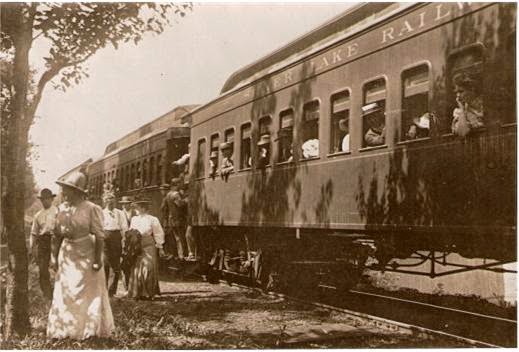
Train at Silver Lake, NY (Pre-1900.)
September 11, Sat. Fanny Keeton and [I] walked up to the lake in the eve and was walking along and I saw Fred Botsford & he bowed & so did I and then he came along with us and took us on a boat riding, in the moon light eve. There was a dance up there from Wethersfield, and so Fred and I and Mary & Fanny got up in one corner and had half a dance. We had piles of fun, and then Mary went off, and Fred got Will Calkins to dance with Fanny, and Fred & myself, and we was just going to have a good time and the 9 o’clock train come, so we had to go and we promenaded down the station and we went in the car. The boys went in to see if we got a seat–and we had and when and when red went out of the car, he took off his hat, and said good evening and threw a kiss.
Matie did all right for herself, as they say. If you are a local, her husband’s name will most likely be familiar. On January 12, 1896 she married William D. Page, who would become the president of the National Bank in Perry. Matie herself would serve on the board of directors for 60 years.

According to a booklet done by the bank in 1955 titled First National Bank One Hundred Years in Perry 1855-1955, as well as obituaries and information in our family files, Matie would not be the first woman in the bank’s history to hold a prestigious position in its lifetime.

If  you are interested in women’s history, the bank holds a little known secret. By every known source, Maggie L. Walker of Virginia is said to be the first woman bank president. To take nothing away from her prestigious career, she is undoubtedly the first African American woman to become president of a bank when she became the first woman to charter a bank in 1903, but not the first woman to own a bank or be president of a bank. I believe that now goes to two women in Perry, NY.


Laura Page Smith, president, 1866-1886
Eliza D. Page, president, 1894-1907
Mary (Matie) C. Page, director, 1896-1956

I will leave you with this fitting poem from her diary, that over 100 years later, describes the feeling of looking at it. If she only knew...

 1875 January 23, Sat.

Forget me not,
forget me never.
Till thy blue eyes
shall close forever.

Remember me
when this you see
and think that I
remember thee.


(The full story I wrote, titled "The Diary of an 1870s Teenager: Matie E. Cole," appeared in the January 2013 issue of Historical Wyoming.)

***

Stay tuned for more history tidbits throughout the month of April!

The list to the other A-Z bloggers is here.

***
If your user name in comments doesn't lead to your A-Z blog, leave the URL so I can find you!
Here's how to do a clickable link to your blog in the comments section:

< a href="http://historysleuth.blogspot.com/">History Sleuth's Writings - Blogging A-Z</a >

Just replace my stuff with yours and take the space out between the < a and a > above.
(Had to put a space in or you would see a link instead of code. :)
Keep it in a note on your desktop so you can copy & keep hitting paste at every blog instead of retyping.

Share:

Friday, April 03, 2015

C is for John Card, Inventor

Our ancestors were quite prolific inventors. Seems everyone was trying to come up with the latestes new gadget. If you ever want to look up any patents, skip the unwieldy, archaic search engine at the government site and go straight to Google Patents.

I searched for all the inventors from the county where I am Assistant County Historian and found quite a few. The fun thing is you can easily download the design.

The following patent was filed by John Card in 1835 from the town of Gainesville. At that time the town was still a part of Genesee County until Wyoming County was formed in 1842. Prior to his residence in Gainesville, John owned the first mill on Lot 40 in the town of Perry in 1820 along with his partner, Sylvester Lathrop. His Patent was for a Smut Mill.

I'd tell you to get that dirty thought out of your head, but, it's probably where it came from. A smut mill was a way to clean the grain from ... well... from the smut. Said smut being a fungus with foul smelling spores---which could very well be where we get the slang meaning for the word. Below is the picture of John's patent.

Stay tuned for more history tidbits throughout the month of April!

The list to the other A-Z bloggers is here.

***
If your user name in comments doesn't lead to your A-Z blog, leave the URL so I can find you!
Here's how to do a clickable link to your blog in the comments section:

< a href="http://historysleuth.blogspot.com/">History Sleuth's Writings - Blogging A-Z</a >

Just replace my stuff with yours and take the space out between the < a and a > above.
(Had to put a space in or you would see a link instead of code. :)
Keep it in a note on your desktop so you can copy & keep hitting paste at every blog instead of retyping.

Share:

Saturday, July 26, 2014

Milk Carton Murders 38

Wiscoy Creek (Yes, it's a real place near where I live.)
SETUP: The three girls whose twenty plus-year-old coffins washed out of the bank of the Wiscoy Creek have been identified as Lisa Appleton, Rachel McKenzie and Samantha Briggs. Samantha was a foster child at Dave's house when he was a kid who he knew as Sally, and it was the last place Dave seen her alive. Last time Pepper tells Dave of the stuffed dog found in the coffin with Samantha. Turns out Dave had given it to her before she disappeared. Pepper explained last week a piece of Balsa wood was found inside the toy with a carved message from the girl. (I'm leaving out part of the convo as it has clues and to keep it to 8 sentences.) Dave is trying to keep the "other voice" he hears in his head at bay, as asks what Samantha wrote. Pepper leads us off...

AND NOW THE SNIPPET:

“On one side it said, ‘Sammy Briggs August 22, 1987’ and underneath it, ‘Remember me, September 28, 1987.’ ”

“The August date had to be the week of the fair,” Dave surmised, "but the September date is after she left us—way after.”

Pepper agreed. “I'm sure she guessed something was going to happen, but what she carved on the other side was even more unsettling."

Dave squelched the other voice in his head from coming to the forefront of his mind. “I almost don’t want to know, but go ahead.”

Pepper looked up at him. “It said—the milk man is evil.”

***
The link to the other Weekend Writing Warriors is here. You're bound to find something to pique your interest.

The Sunday Snippet writer's on Facebook are here. Between the two there is something for everyone. Thank you for any comments you leave me. Much appreciated!

*** 
BLURB:
When three small coffins are unearthed near the Wiscoy Creek during a routine dredging operation, it’s the last thing DAVE ROBERTSON, of the Lamont Weekly Times, expected. Pinned to the skeleton’s clothing are pictures from milk cartons of missing girls.

Dave is stunned to find that one of the girls is Sally―a foster child his parents had cared for through the Friends of Foster Families (FFF) program. Cold case files reveal the girls disappeared over 20 years ago. Knowing his house was the last place he saw Sally alive, he can’t help but suspect his dad.

How can he write the biggest story of his career if his father turns out to be the killer? If the voice in his head would shut up and let him remember, he might figure it out before he loses his mind and his dad is charged with murder.

Full blurb and snippet recap here.


 ***

My blog may look different again when you stop next week. Some things with this one don't work right, like the side show. :(
It is canning and freezing time so I may not get to all of you on Sunday. I must take advantage of hubby being home to help. I shall be visiting blogs all week though. :)
Share:

Wednesday, April 16, 2014

N is for NOTORIOUS Ned Lyons


There were several attempted bank robberies in our county during the late 1800s and early 1900s. To date, the following is the first robbery case I have encountered with off shoots of political corruption of the era, and infamous criminals that connected us to New York City, “Boss Tweed”, and—like the movie of the same name—the Gangs of New York. The planning and execution of their crimes also brought to mind the movie The Sting, and a more modern comparison, Ocean’s 13—not to mention the truly brilliant schemes to break out of jail. This was a gang of profession thieves who would be immortalized in books on the most notorious criminals of the late nineteenth century.

During the middle of the night on September 20, 1870 an explosion ripped through the sleeping village of Perry, NY. Another useless attempt was being made to rob Smith’s Bank. Henry N. Page, bank president, inspected the vault. The money inside remained untouched and tools lay everywhere. The clock on the vault indicated the first attempt to blow the safe was at 12:45 a.m. It could be that not enough gun powder was used to produce a large enough explosion to open the safe. The men must have attempted to open it using their tools as the second blast did not occur until 2:45 a.m. This time it was so loud there was no way to escape detection thus leaving them no time to rob the safe—instead, they ran.

NED LYONS
At the time of their arrest, the men gave their names as Robert E. Hapgood, 30; James J. Watson, 28; and John Hayes, 21. Our local law enforcement had no idea who they really had in custody at the time of the arrest and prosecution. Another month would pass before they discovered that these men were not average thieves but notorious safe crackers out of New York City that made the hit on Smith’s Bank. Robert E. Hapgood was really the notorious bank robber Ned Lyons. James J. Watson was really Jimmy Hope, the leader of a New York City gang. John Hughes was a petty criminal who fell in with the wrong crowd and whose real name was John A. Hayes. I believe, after pulling two major heists in Pennsylvania, they headed north to western New York to lay low—but just couldn’t resist the urge to rob the little bank in the village of Perry.

Ned Lyons was defended by an attorney, who at the time was said to be one of the best lawyers in Buffalo—A. P. Lanning, Esq. His help was to no avail. All three suspects were convicted in November under the above aliases and sentenced to five years in Auburn State Prison.  Because of Ned's ballot box stuffing expertise in New York City, Ned and his wife Sophie had connections with politicians. Sophie engaged the help of a politician, and lawyer in our area of this state, to try and get her husband moved from Auburn prison to Sing Sing where it was easier to buy your way out of jail. 


SOPHIE LYONS
On February 6, 1871 Ned Lyons was transferred to Sing Sing prison. He wouldn’t be there long. Sophie, a criminal herself, arranged his escape. Over the next decade both would be in and break out of prison several times, and as they aged and gave up their robbing ways, it was finally decided it was less costly to just leave them be. But just so everyone would know, a notice was often printed in the newspaper to hold on to your valuables; Ned and Sophie were back in the city. Sophie eventually divorced Ned and remarried a different criminal, whom she also left. Sophie went straight and used much of her ill gotten gains to invest in real estate and charitable causes, and even wrote a very colorful autobiography. Ned died a penniless criminal has-been.


If you would like to read more on their exploits and other notorious criminals of the day, complete with photographs, you can get the following books for free at http://www.archive.org in any format. I prefer the PDF files as they are scans of the original pages.

Professional Criminals of America by Thomas Byrnes (Cassell & Company, Ltd: 1886)
Our Rival the Rascal by Benjamin P. Eldridge and William B. Watts (Pemberton Publishing Co.:1896)
Why Crime Doesn’t Pay by Sophie Lyons Burke J. S. Ogilvie Publishing Co.: 1913)

The previous post is a small excerpt from "The Gangs of New York Hit Smith's Bank in Perry" by Cindy Amrhein (me) which appeared in the July 2013 issue of Historical Wyoming.

***

The list to the other A-Z bloggers is here.
If your user name in comments doesn't lead to your A-Z blog, leave the URL so I can find you!
 
Here's how to do a clickable link to your blog in comments:
< a href="http://historysleuth.blogspot.com/">History Sleuth's Writings - Blogging A-Z</a >
Just replace my stuff with yours and take the space out between the < a and a >
(Had to put a space in or you would see a link instead of code. :)
Keep it in a note on your desktop so you can copy & keep hitting paste at every blog instead of retyping. 


Share:

Available in paperback and eBook formats

Available in paperback and eBook formats

Now Available At:

Barnes & Noble
Amazon
The History Press
Walmart

Carried by over 40 college/university libraries across the county, according to daily updates by worldcat.org, including Columbia University, Oklahoma State, Texas A & M, and Yale University Law Library.

Book Trailer

Weekend Writing Warriors

Weekend Writing Warriors
WeWriWa

Bread & Butter the Murders of Polly Frisch

Bread & Butter the Murders of Polly Frisch
Available on Amazon

Other Great Reads

Followers

Recent Posts

A to Z - 2015

A to Z - 2014

A to Z - 2014

A to Z - 2013

A to Z - 2013

Goodreads

Cindy's bookshelf: read

Waiting for Harvey
4 of 5 stars
Alone, in a cabin in the woods, with a ghost. Who could ask for more in a ghost story? Harvey starts right out with a hint of foreboding in a conversation between brothers John and Erik. Already my curiosity is roused as to what happened...
tagged: books-i-read-to-me
James Potter and the Curse of the Gate Keeper
3 of 5 stars
I randomly downloaded this on my iPad when I hit the wrong button being a bumble fingers, so I thought I'd give it a shot. I've never read fanfic before. It was pretty good. But like many other people, it still can't compare to J. K. Row...
CHIMERAS
5 of 5 stars
I beta read a few chapters of a different book by this author (one that isn't out yet) so when this one was out I had to read it as it was the same character in the one a betaed a bit of--the character of Track. I have a fondness for thi...
tagged: books-i-read-to-me

goodreads.com